Japan and temperate East Asia, Singapore and tropical Asia
Season
summer, autumn
Shape
spike
Identification
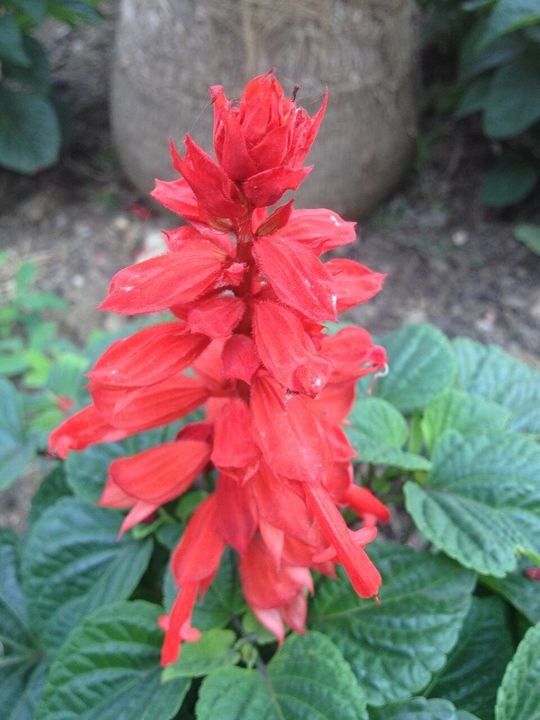
A tender perennial from the Brazilian highlands, the wild form to 1.3 m and rarely grown; bedding plants are dwarf cultivars. Opposite elliptical leaves 7 by 5 cm, toothed, long-stalked. Erect spikes rise from the centre with two to six flowers per node, scarlet, tubular to bell-shaped, 35 mm long, two-lipped with a 13 mm upper lobe; the calyx is scarlet too and persists after the flowers fall, so the whole spike stays red for weeks like a string of firecrackers, which is its Chinese name. Cultivars also purple, white and pink.
Habitat
Beds and pots, one of the most planted bedding plants in shopping malls and public gardens worldwide; its homeland is 2,000–3,000 m up, warm and humid all year.
Distribution
Native to Brazil; very common in beds across China, above all in northern beds around National Day, common in Japanese summer and autumn beds (sarubia), grown in Singapore's beds and flower shows.
Season and behaviour
Summer and autumn, July to October in the north with a peak around National Day, longer in southern China and Singapore; a spike lasts weeks.
Photography tips
These are the FilmAnalysis editors' notes, not content from the sources.
Scarlet is the colour digital sensors clip first: a stop under, saturation boost off, steadiest under cloud. Spikes in a portrait frame, macro for the two-lipped tubes and persistent red calyces. Massed beds compress to a red block with a long lens, or go low so red spikes stand against the sky. Butterflies and hummingbird hawkmoths visit, 1/1600 s.
Photographic styles
Red spikes against the sky from low down; a red block of bedding.
Similar species
Salvia coccinea (smaller sparser flowers, green calyx); mealycup sage, Salvia farinacea (blue-violet); red-flowered garden sage hybrids.
Related badge
None yet. No validated photo recognition exists for this species, so no badge is tied to it: a name in the encyclopedia is not evidence in a photograph.
The illustration is original FilmAnalysis artwork. The photograph is from Wikimedia Commons; its licence and author are under it.
Why it is listed: this species comes from the Flower checklist (GBIF backbone and Wikidata verified). Names follow the GBIF backbone and Wikidata; the facts follow the sources below; photo recognition is not offered.