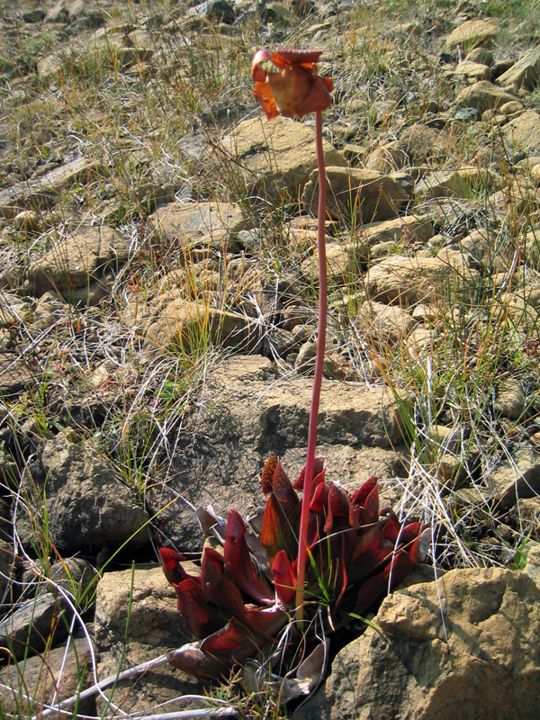
Photo: Shipguy, via Wikimedia Commons, public domain / CC0. Unmodified apart from resizing.
Colour
purple, red, green
Region
Elsewhere (in East Asia only in bird parks or botanic gardens)
Season
spring, summer
Shape
single flower
Identification
A carnivorous plant whose leaves roll into squat sprawling pitchers, green with purple-red veins and turning purple overall in sun (the epithet), the lid upright and not covering the mouth, so the pitcher fills with rain in which insects drown and are broken down by bacteria and the pitcher's small community. Solitary nodding purple-red flowers on tall scapes, five petals hanging round a large umbrella-like style disc, like an upturned parasol. The most widespread and common Sarracenia and the only one of cold temperate climates; the provincial flower of Newfoundland and Labrador.
Habitat
Poor acid peat bogs in full sun and moisture; a pot plant worldwide, naturalised in Europe.
Distribution
Native to the eastern seaboard of North America, the Great Lakes, nearly all of Canada, and Washington State and Alaska; entirely cultivated in East Asia, common among Japanese carnivorous-plant growers and in garden centres (murasaki-heishisō), occasional in Chinese and Singaporean flower markets.
Season and behaviour
Flowers in May and June; pitchers grow in spring, colour deepest by late summer and persist through winter.
Photography tips
These are the FilmAnalysis editors' notes, not content from the sources.
Sprawling pitchers mean lying down at their level, with a macro for the purple-red veins and the hairs at the mouth; against the light the pitcher is translucent and shows the water level. From above for reflections and drowned insects in the mouth. The flower stands above the pitchers and its parasol style disc wants a view from below. Cultivated plants; never collect.
Photographic styles
A translucent purple pitcher against the light; a flower like an upturned parasol.
Similar species
Upright pitcher plants such as Sarracenia flava (tall straight pitchers, lid over the mouth); Nepenthes (pitchers from leaf tips, climbers); cobra lily (hooded like a snake's head).
Related badge
None yet. No validated photo recognition exists for this species, so no badge is tied to it: a name in the encyclopedia is not evidence in a photograph.
The illustration is original FilmAnalysis artwork. The photograph is from Wikimedia Commons; its licence and author are under it.
Why it is listed: this species comes from the Flower checklist (GBIF backbone and Wikidata verified). Names follow the GBIF backbone and Wikidata; the facts follow the sources below; photo recognition is not offered.