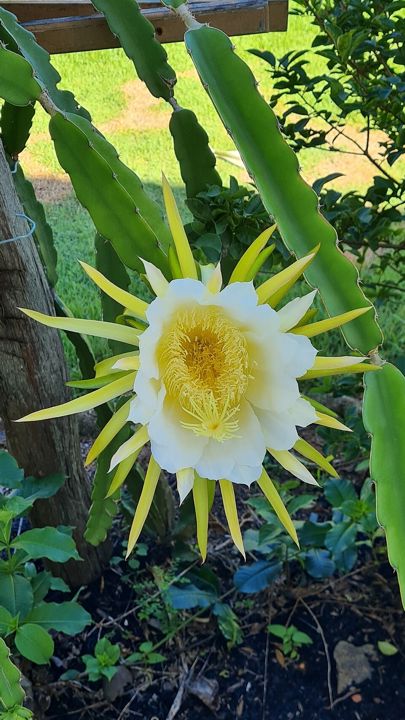
Photo: Tiago Lubiana, via Wikimedia Commons, public domain / CC0. Unmodified apart from resizing.
Colour
white, yellow
Region
Singapore and tropical Asia
Season
summer, autumn
Shape
large head
Identification
A climbing or sprawling cactus, lithophytic or hemiepiphytic, with three-angled green stems with wavy margins and small areoles, climbing rocks, trunks and walls by aerial roots to 10 m or more. Huge flowers 25–30 cm long, white with yellow-green outer tepals, opening at night and fading by dawn, fragrant; the fruit is the white-fleshed dragon fruit, red-skinned with green scales. Possibly of hybrid origin.
Habitat
Dry forest and rocky slopes in its homeland; now widely grown as a fruit crop in the tropics and subtropics and as an ornamental wall climber, naturalised in Fujian, Guangdong, Hainan, Guangxi and Taiwan.
Distribution
Native from southern Mexico to Honduras and grown throughout the tropics and subtropics; dragon fruit is farmed on a large scale in southern China and Taiwan, it climbs garden walls in Singapore, and it is grown in Okinawa.
Season and behaviour
Night flowers from May to October, June to September in southern China; each flower lasts one night. Fruit June to December.
Photography tips
These are the FilmAnalysis editors' notes, not content from the sources.
Night opening is the whole difficulty: watch a bud due to open at dusk, with a tripod and continuous light (or moonlight and a long exposure); the flower is fully open around nine or ten at night and closes before dawn. The huge white flower in darkness wants half a stop under and no frontal flash. Rows of trellises and hanging fruit in an orchard are the daytime subject.
Photographic styles
A giant white flower opening at night; trellises and red fruit in an orchard.
Similar species
Queen of the night, Epiphyllum oxypetalum (flat spineless stems, similar flower, no dragon fruit); red-fleshed pitaya, Selenicereus costaricensis; other night-flowering cacti.
Related badge
None yet. No validated photo recognition exists for this species, so no badge is tied to it: a name in the encyclopedia is not evidence in a photograph.
The illustration is original FilmAnalysis artwork. The photograph is from Wikimedia Commons; its licence and author are under it.
Why it is listed: this species comes from the Flower checklist (GBIF backbone and Wikidata verified). Names follow the GBIF backbone and Wikidata; the facts follow the sources below; photo recognition is not offered.