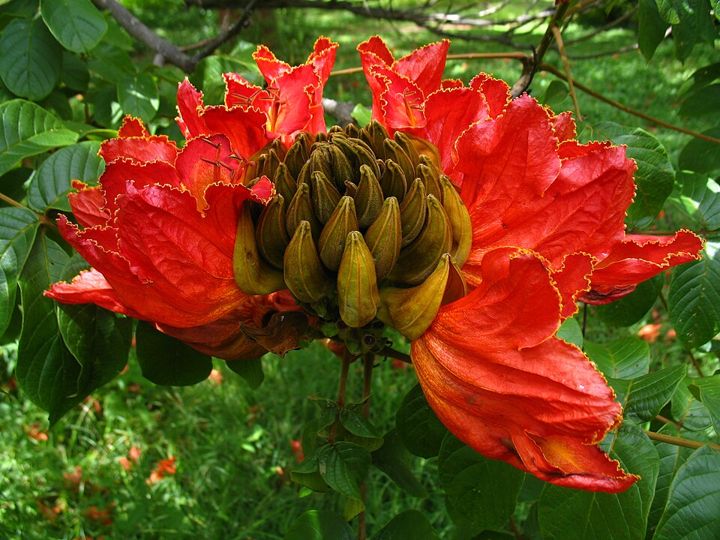
An evergreen tree 7–25 m tall, usually about 15 m, with rather thick bark. Pinnate leaves with pointed leaflets, deep green. The flower bud is ampule-shaped and full of water, squirting when squeezed, a children's toy whose sap stains fingers yellow; the flowers are large bells, reddish-orange outside and yellow within, like tulips, crowded in terminal heads, the open flowers cup-shaped and holding rain and dew that attracts many birds. Capsules with winged seeds. Nominated among the world's hundred worst invaders.
Habitat
Tropical streets, parks, campuses and waste ground, extremely fast-growing and invasive on many tropical islands; native to the tropical dry forests of Africa.
Distribution
Native to Africa and planted throughout the tropics as an ornamental; a common street and park tree in Singapore, widely planted in Hong Kong, Taiwan and southern China (Guangdong, Hainan, Yunnan), and in Japan only in Okinawa. Larger and showier flowers than the flame tree.
Season and behaviour
Flowers on and off all year in the tropics, peaking in Singapore and Hong Kong from late winter to early spring (December to March); the heads on the crown look like flames.
Photography tips
These are the FilmAnalysis editors' notes, not content from the sources.
The flowers are on the crown, so a long lens from below or a high viewpoint at eye level; against the sky the orange-red stands out but tends to silhouette, so add a stop, and cloud gives the truest colour. Fallen flowers carpet the ground in orange-red for a view straight down. The water-filled cups and birds coming to drink are the ecological picture at 1/1600 s.
Photographic styles
Orange-red flames on the crown; fallen flowers from above.
Similar species
Flame tree (red, feathery leaves, smaller flowers, summer); red cotton tree (flowers before leaves, fleshy red, spring); flame vine (a climber with orange tubular flowers).
Related badge
None yet. No validated photo recognition exists for this species, so no badge is tied to it: a name in the encyclopedia is not evidence in a photograph.
The illustration is original FilmAnalysis artwork. The photograph is from Wikimedia Commons; its licence and author are under it.
Why it is listed: this species comes from the Flower checklist (GBIF backbone and Wikidata verified). Names follow the GBIF backbone and Wikidata; the facts follow the sources below; photo recognition is not offered.