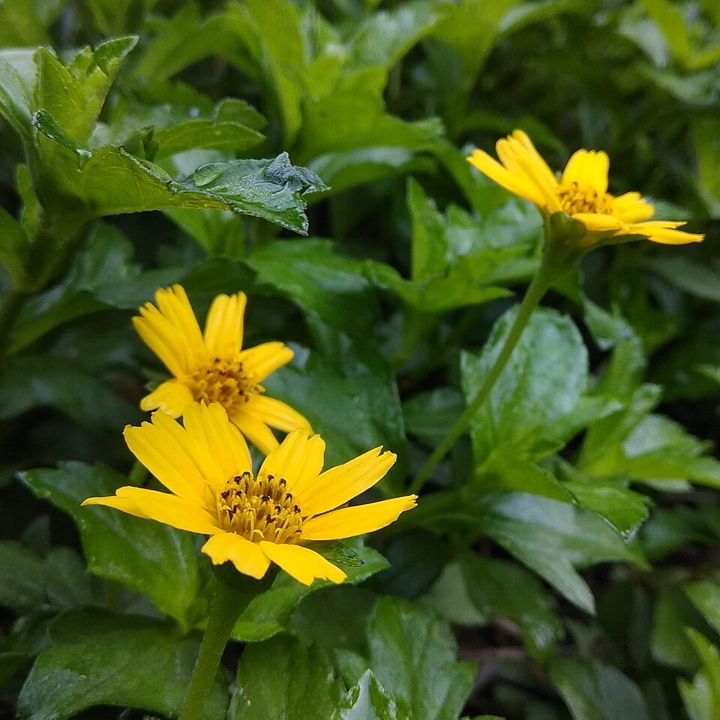
A spreading mat-forming perennial up to 30 cm high, with rounded stems to 40 cm long rooting at the nodes and ascending flowering stems. Fleshy hairy leaves 4–9 cm long, serrate or irregularly toothed, usually with a pair of lateral lobes, dark green above and lighter below. Bright yellow heads like small sunflowers. Listed by the IUCN among the world's hundred worst invasive species.
Habitat
Sunny, well-drained but moist lowlands: roadsides, river banks, park slopes and coasts, widely planted as groundcover and escaped. A very wide ecological tolerance.
Distribution
Native to Mexico, Central America and the Caribbean, now throughout the Neotropics and spread to the Old World tropics; very common in Singapore (hence the name Singapore daisy) and naturalised in southern China, Taiwan and southern Japan.
Season and behaviour
Flowers all year in the tropics, most after the rains; freshest in the early morning.
Photography tips
These are the FilmAnalysis editors' notes, not content from the sources.
A carpet of yellow wants a wide lens from low down for depth, a single flower a head-on macro for the radiating petals; yellow clips easily in strong sun, so half a stop under or an overcast day. A roadside carpet against the city is an everyday Singapore picture.
Photographic styles
Wide views of yellow carpets; single-flower macro.
Similar species
Sphagneticola calendulacea (the native species, narrower leaves, smaller flowers); other yellow daisy groundcovers.
Related badge
None yet. No validated photo recognition exists for this species, so no badge is tied to it: a name in the encyclopedia is not evidence in a photograph.
The illustration is original FilmAnalysis artwork. The photograph is from Wikimedia Commons; its licence and author are under it.
Why it is listed: this species comes from the Flower checklist (GBIF backbone and Wikidata verified). Names follow the GBIF backbone and Wikidata; the facts follow the sources below; photo recognition is not offered.