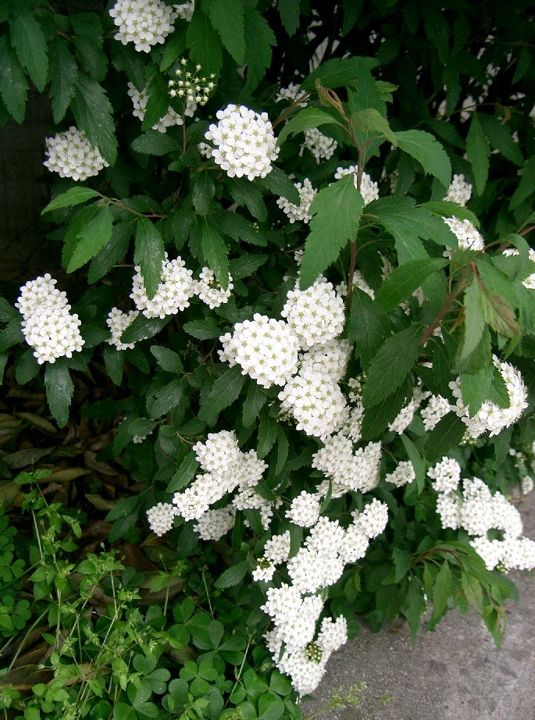
A deciduous or semi-evergreen shrub 1–2 m tall with many thin, arching, flexible hairless branches. Alternate short-stalked leaves, lanceolate, elliptic-rhomboid or slightly obovate, 2–6 cm, three-veined from the base and irregularly crenate-dentate in the upper half, sometimes turning yellow-red in autumn. Snow-white spring flowers, bisexual and actinomorphic, about 1 cm across, in axillary corymbs with five sepals, five white petals and many stamens shorter than the petals; the double form strings white pompons along the arches, hence bridalwreath.
Habitat
Hillside scrub, streamsides and rocky slopes, widely planted in gardens, parks and along fences; takes clipping well.
Distribution
Native to south-east China (the epithet means of Canton), common in central and southern China; introduced and naturalised in Japan (kodemari, grown since before the Edo period), Assam, the Azores, southern Brazil and elsewhere. Absent from Singapore.
Season and behaviour
April and May, late April to May in Japan; about two weeks, with the late cherries and azaleas.
Photography tips
These are the FilmAnalysis editors' notes, not content from the sources.
Strings of white balls along arching branches are a subject of line and repetition: compress along the branch with a long lens against a dark wall or tree shade, half a stop to a stop under for white. Macro for the layered petals of a double ball. Kodemari with a stone lantern in a Japanese tea garden is the traditional frame.
Photographic styles
Strings of white balls on arches; white lines before a dark background.
Similar species
Thunberg's spiraea (smaller earlier flowers, linear leaves); Japanese spiraea (pink flat heads in summer); Spiraea prunifolia (double white, smaller flowers).
Related badge
None yet. No validated photo recognition exists for this species, so no badge is tied to it: a name in the encyclopedia is not evidence in a photograph.
The illustration is original FilmAnalysis artwork. The photograph is from Wikimedia Commons; its licence and author are under it.
Why it is listed: this species comes from the Flower checklist (GBIF backbone and Wikidata verified). Names follow the GBIF backbone and Wikidata; the facts follow the sources below; photo recognition is not offered.