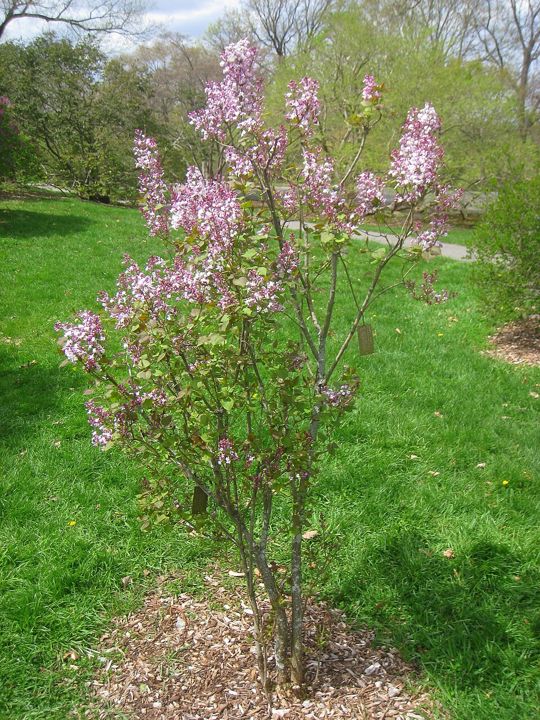
Photo: Daderot, via Wikimedia Commons, public domain / CC0. Unmodified apart from resizing.
Colour
purple, white
Region
Japan and temperate East Asia
Season
spring
Shape
cluster
IUCN status
Least Concern
Identification
A shrub or small tree 3.5–5 m. Ovate-orbicular to kidney-shaped leaves often slightly wider than long, 2.5–10 cm, with a truncate to shallowly heart-shaped base and an abruptly pointed tip, often colouring red in autumn. Lateral panicles 4–16 cm long of purple (white in one form) four-lobed intensely fragrant flowers. Like the common lilac but earlier and with very different leaves. The lilac most often seen in China and the scent of northern cities in spring.
Habitat
Hillside thickets, ravines, streamsides and roadsides at 300–2,400 m; widely planted in northern gardens, temples and streets.
Distribution
Native to northern and western China (Gansu, Hebei, Henan, Jilin, Liaoning, Inner Mongolia, Ningxia, Qinghai, Shaanxi, Shanxi, Shandong, Sichuan) and Korea; very common in Beijing, Harbin and Xining (both of which have it as city flower) and other northern cities, grown in Japan (murasaki-hashidoi, though Hokkaido has more common lilac). Absent from Singapore.
Season and behaviour
April and May, mid to late April in Beijing with the crabapples; about two weeks, scent strongest at dusk.
Photography tips
These are the FilmAnalysis editors' notes, not content from the sources.
The purple panicles are truest in soft light and shift blue-violet in sun, half a stop under; a stop under for the white form. Macro for the four-lobed florets and the occasional five-lobed lucky lilac. The grey walls and red pillars of northern temples are the traditional backdrop, compressed with a long lens. Scent is the subject, so photograph someone under the flowers. The red autumn leaves are another season's picture.
Photographic styles
Purple lilac before a grey wall; macro of four-lobed florets.
Similar species
Common lilac, Syringa vulgaris (ovate tapering leaves, slightly later, many cultivars); Amur lilac (white, large panicles, early summer); Peking lilac (white-yellow, June).
Related badge
The album badge "lilac" unlocks when the vision model explicitly names a lilac in your photo and you rate the analysis. The badge stops at "lilac": it does not tell species apart, and this page existing unlocks nothing.
The illustration is original FilmAnalysis artwork. The photograph is from Wikimedia Commons; its licence and author are under it.
Why it is listed: this species comes from the Flower checklist (GBIF backbone and Wikidata verified). Names follow the GBIF backbone and Wikidata; the facts follow the sources below; photo recognition is not offered.