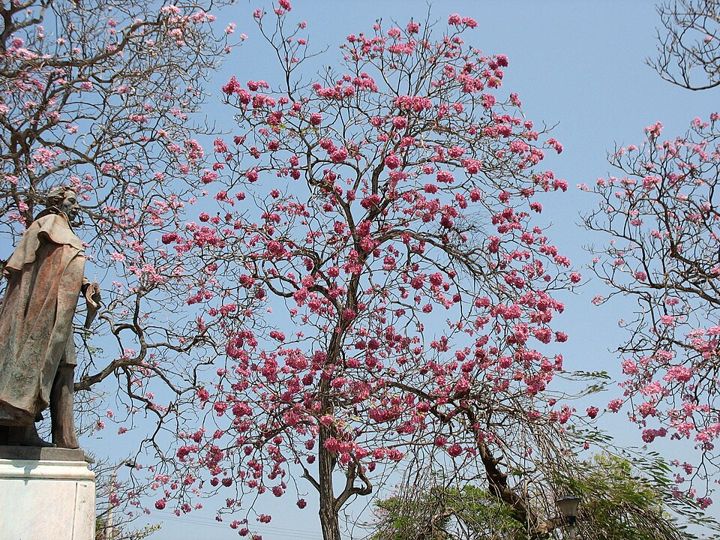
Photo: José David Villalobos Robles, via Wikimedia Commons, licensed CC BY 3.0. Unmodified apart from resizing.
Colour
pink, white, purple
Region
Singapore and tropical Asia
Season
spring, year-round
Shape
cluster
IUCN status
Least Concern
Identification
A neotropical tree up to 30 m with a trunk up to a metre across, short in habit with irregular layered branching and few thick limbs, the bark grey to brown and vertically fissured. Palmate deciduous leaves of five leaflets, the middle largest. Flowers cover the leafless tree in the dry season, pink to pale purple (also near white), trumpet-shaped with a yellow throat, in clusters at the branch tips, the whole tree a pink cloud, hence Sakura Malaysia; Singapore's trees flower together after rain and are called the Singapore sakura. Long slender capsules. Oak-like wood, savannah oak in Costa Rica; the national tree of El Salvador. Introduced to Taiwan in 1967.
Habitat
Tropical lowland forest and savannah from sea level to 1,200 m at 20–30 °C; widely planted as a street and park tree in tropical cities.
Distribution
Native from southern Mexico to Venezuela and Ecuador; very common as a street and park tree in Singapore, where it is one of the best-known flowering trees, grown in southern China (Guangdong, Hainan) and Taiwan, glasshouse-only in Japan.
Season and behaviour
January and February in the dry season at home; no fixed season in Singapore, where a heavy rain after a dry spell, usually in March–April and August–September, triggers a city-wide bloom lasting about a week.
Photography tips
These are the FilmAnalysis editors' notes, not content from the sources.
The mass bloom lasts only days and Singaporeans alert each other on social media, so go the day you hear. A whole tree like a pink cloud against blue sky and housing blocks is the local emblem, wide from below or compressed with a long lens; the pink carpet of fallen flowers is the other half, low with people walking through. Macro for the yellow throat of one trumpet. Half a stop under for pink in sun.
Photographic styles
A pink cloud of blossom before housing blocks; a pink carpet of fallen flowers.
Similar species
Golden trumpet tree, Handroanthus chrysotrichus (yellow); the Chinese name pink trumpet tree is sometimes applied to other Handroanthus; rosy trumpet tree is another name for this species. Cherry blossom (temperate, small flowers singly or in umbels).
Related badge
None yet. No validated photo recognition exists for this species, so no badge is tied to it: a name in the encyclopedia is not evidence in a photograph.
The illustration is original FilmAnalysis artwork. The photograph is from Wikimedia Commons; its licence and author are under it.
Why it is listed: this species comes from the Flower checklist (GBIF backbone and Wikidata verified). Names follow the GBIF backbone and Wikidata; the facts follow the sources below; photo recognition is not offered.