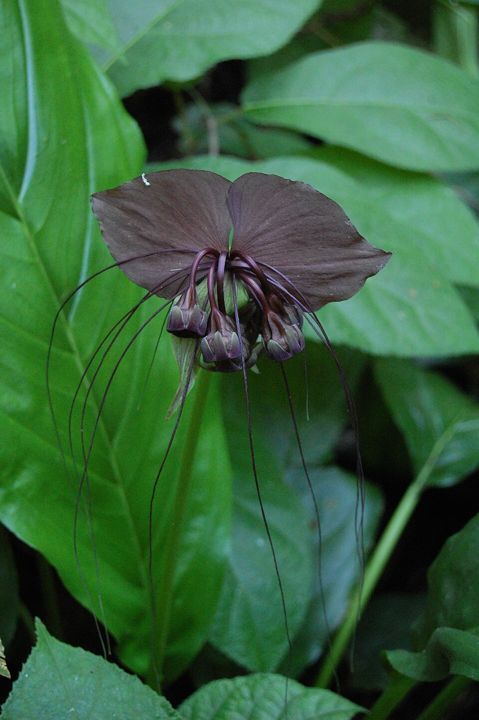
A perennial of the yam family 50–100 cm tall. Large oblong-elliptic basal leaves. A strange inflorescence: deep purple-brown to near-black flowers in an umbel, with four bracts in two pairs, the outer smaller and set one above the other, the inner large like a bat's spread wings, the whole up to 30 cm across; many long thread-like bracteoles hang like whiskers 20–25 cm long, hence black bat flower, cat's whiskers and devil flower. Black flowers are very rare among plants. Mostly self-pollinating. Used in traditional Chinese medicine.
Habitat
Tropical forest floor, streamsides and shaded damp valleys at 170–1,300 m, in high humidity and diffuse light; grown as a curiosity in botanic gardens and glasshouses.
Distribution
Native to South-East Asia (Cambodia, Laos, Vietnam, Thailand, Malaysia, Singapore) and southern China (Guangdong, Hunan, Yunnan, Guangxi); recorded wild in Singapore and shown in its botanic gardens, wild and cultivated in southern China, glasshouse-only in Japan.
Season and behaviour
April to November in southern China, nearly all year in the tropics; one inflorescence lasts weeks.
Photography tips
These are the FilmAnalysis editors' notes, not content from the sources.
A near-black flower swallows light, so add a stop or more; side or back light draws the edges of the bracts and the whiskers, and a pale background works better than a dark one. The whole inflorescence at eye level for the bat shape, macro for the flowers. Forest light is dim, so a tripod. A rare wild plant: never pick it.
Photographic styles
Black flowers like bat wings; whiskers edged by backlight.
Similar species
White bat flower, Tacca integrifolia (white bracts); other Tacca; no other common flower looks like it.
Related badge
None yet. No validated photo recognition exists for this species, so no badge is tied to it: a name in the encyclopedia is not evidence in a photograph.
The illustration is original FilmAnalysis artwork. The photograph is from Wikimedia Commons; its licence and author are under it.
Why it is listed: this species comes from the Flower checklist (GBIF backbone and Wikidata verified). Names follow the GBIF backbone and Wikidata; the facts follow the sources below; photo recognition is not offered.