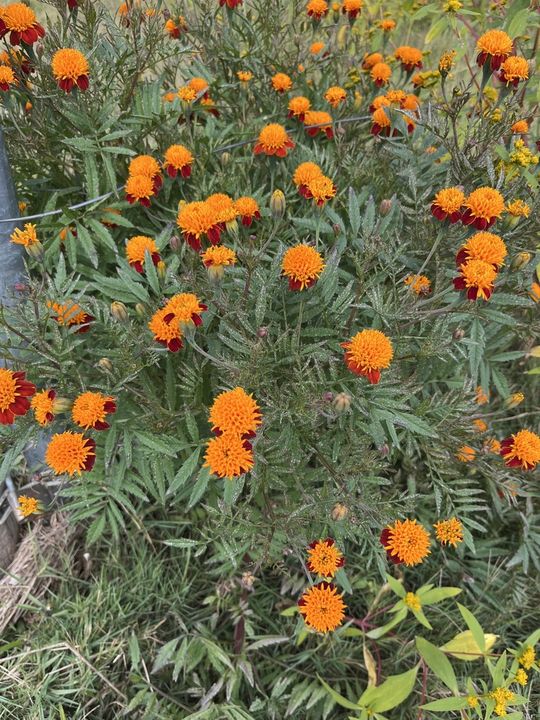
Photo: Prince Molokomme, via iNaturalist, public domain / CC0. Unmodified apart from resizing.
Colour
orange, yellow
Region
Japan and temperate East Asia, Singapore and tropical Asia
Season
summer, autumn
Shape
large head
Identification
An annual or perennial herb 30–110 cm tall. Striated stems with resin channels in the bark, strongly aromatic when squeezed. Leaves opposite below and alternate above, up to 20 cm long, pinnate with 11–17 lanceolate toothed leaflets dotted with round glands. Heads solitary on stalks up to 15 cm, in cultivars large dense double balls of orange or yellow. Native to Mexico, the cempasúchil of the Day of the Dead; the petals yield the food colour E161b (lutein). Often called African marigold despite its American origin.
Habitat
Beds, roadside meadows and gardens, sown in spring, the large long-lasting flowers making it the standard bedding plant; wild on roadsides at 1,150–1,480 m in its homeland.
Distribution
Native to Mexico (the states of México, Michoacán, Puebla, Veracruz and Guerrero) and Central America; widely grown for ornament across China, as a summer bedding plant in Japan (senjugiku, African marigold), and common in Singapore's beds and as Hindu temple flowers.
Season and behaviour
June to October, summer and autumn in the north and almost all year in the tropics; one head lasts two weeks or more.
Photography tips
These are the FilmAnalysis editors' notes, not content from the sources.
The double orange ball straight down is the most graphic view, the ruffled petals having depth only in side light; orange bleeds in sun, so a stop under and watch the red channel. A bed compresses with a long lens into a block of colour. Marigold garlands at Hindu temples are a documentary subject. The smell of the crushed leaves cannot be photographed, but the butterflies on the flowers can.
Photographic styles
Orange balls seen from above; blocks of colour in garlands and beds.
Similar species
French marigold (low, small flowers, often with red-brown); sulphur cosmos (single, broad leaf segments); zinnia (opposite undivided leaves, many colours).
Related badge
None yet. No validated photo recognition exists for this species, so no badge is tied to it: a name in the encyclopedia is not evidence in a photograph.
The illustration is original FilmAnalysis artwork. The photograph is from iNaturalist; its licence and author are under it.
Why it is listed: this species comes from the Flower checklist (GBIF backbone and Wikidata verified). Names follow the GBIF backbone and Wikidata; the facts follow the sources below; photo recognition is not offered.