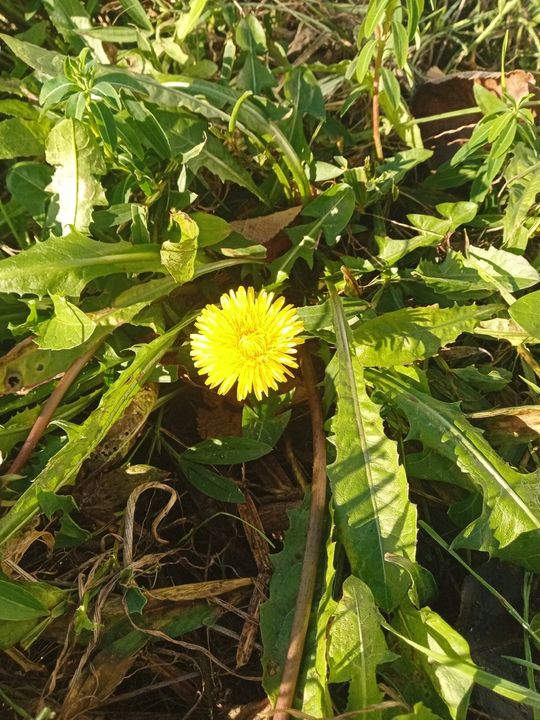
Photo: Peter Beresford, via iNaturalist, public domain / CC0. Unmodified apart from resizing.
Colour
yellow, white
Region
Japan and temperate East Asia
Season
spring, summer
Shape
single flower
Identification
A perennial from a usually unbranched taproot; hollow leafless flower stems typically 5–40 cm tall, occasionally 70 cm, sometimes tinted purple, held as tall as or taller than the leaves. All leaves basal, with unwinged or narrowly winged petioles; the plant has milky latex. Yellow heads of ligulate bisexual florets only, without receptacle bracts; after flowering a round white ball of silver-tufted fruits that blow away, the clock or blowball. Most lineages set seed by apomixis.
Habitat
Lawns, roadsides, field banks, low grassland and forest meadows at 700–2,200 m; a vigorous weed everywhere, also a wild vegetable and herb.
Distribution
Native to Eurasia and now on every temperate continent; in China in Xinjiang and elsewhere, the dandelions of eastern city lawns being a mixture of this and native Taraxacum species; naturalised throughout Japan (seiyō-tanpopo) and often commoner than the native ones. Absent from Singapore.
Season and behaviour
Peak bloom March to June, sporadic all year in warm places; the flowers open in sun and close in cloud, and the clocks appear a week or two after flowering.
Photography tips
These are the FilmAnalysis editors' notes, not content from the sources.
The yellow flower and the white clock are two pictures: a head-on macro for the flower, and backlight for the clock so every pappus hair glows, with a dark background essential. The moment it is blown apart needs bursts at 1/2000 s, with a friend to blow. On a lawn get down to the ground so the grass blurs green in front.
Photographic styles
Backlit white clocks; yellow dots on grass.
Similar species
Native dandelions such as Taraxacum mongolicum (outer bracts pressed up, not reflexed); sowthistles and hawksbeards (leafy, branched flower stems).
Related badge
None yet. No validated photo recognition exists for this species, so no badge is tied to it: a name in the encyclopedia is not evidence in a photograph.
The illustration is original FilmAnalysis artwork. The photograph is from iNaturalist; its licence and author are under it.
Why it is listed: this species comes from the Flower checklist (GBIF backbone and Wikidata verified). Names follow the GBIF backbone and Wikidata; the facts follow the sources below; photo recognition is not offered.