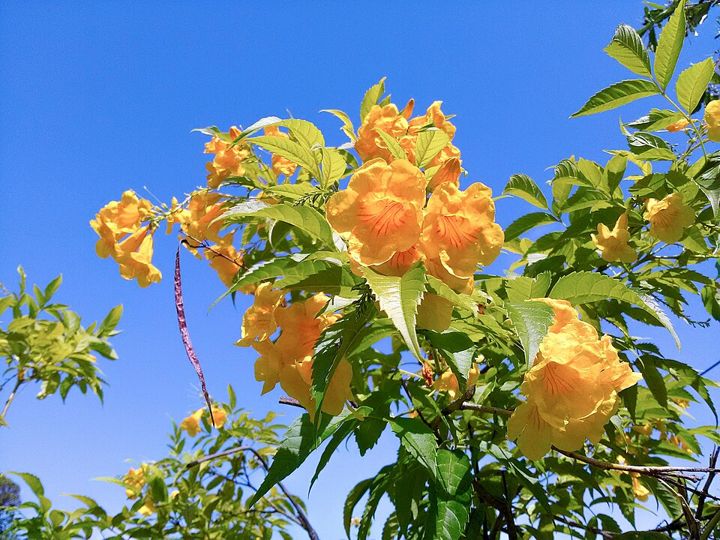
A semi-evergreen shrub or small tree to 10 m. Opposite odd-pinnate leaves with three to thirteen serrate leaflets 8–10 cm long, glabrous, lanceolate and long-acuminate. Large showy golden yellow trumpets in clusters at the branch tips, the corolla bell- to funnel-shaped, five-lobed and weakly two-lipped, often red-veined in the throat, 3.5–8.5 cm long. Narrow capsules up to 25 cm long hold many yellow seeds with membranous wings, spread by wind. The official flower of the US Virgin Islands and the floral emblem of the Bahamas.
Habitat
Roadsides, parks and gardens of tropical cities, drought-tolerant and sun-loving; a weed in some regions.
Distribution
Native to the Americas from the southern United States through Mexico and Central America to northern South America; common on Singapore's roadsides and housing estates, grown in southern China (Guangdong, Hainan, Yunnan) and Taiwan, and in Okinawa and glasshouses in Japan.
Season and behaviour
On and off all year in the tropics, most in spring and summer; a tree of gold after the rains in Singapore.
Photography tips
These are the FilmAnalysis editors' notes, not content from the sources.
Golden trumpets blow out in direct sun, so a stop under, or wait for cloud and evening; against the light the corolla turns translucent and the red throat veins show. A tree in full flower compresses to a yellow block with a long lens; a single cluster in macro for the throat. The long capsules hanging after flowering are another subject.
Photographic styles
Clusters of golden trumpets; translucent corollas against the light.
Similar species
Other Tecoma species; golden trumpet tree, Handroanthus chrysotrichus (flowers on bare branches, palmate leaves); yellow allamanda (yellow, whorled leaves, a vine).
Related badge
None yet. No validated photo recognition exists for this species, so no badge is tied to it: a name in the encyclopedia is not evidence in a photograph.
The illustration is original FilmAnalysis artwork. The photograph is from Wikimedia Commons; its licence and author are under it.
Why it is listed: this species comes from the Flower checklist (GBIF backbone and Wikidata verified). Names follow the GBIF backbone and Wikidata; the facts follow the sources below; photo recognition is not offered.