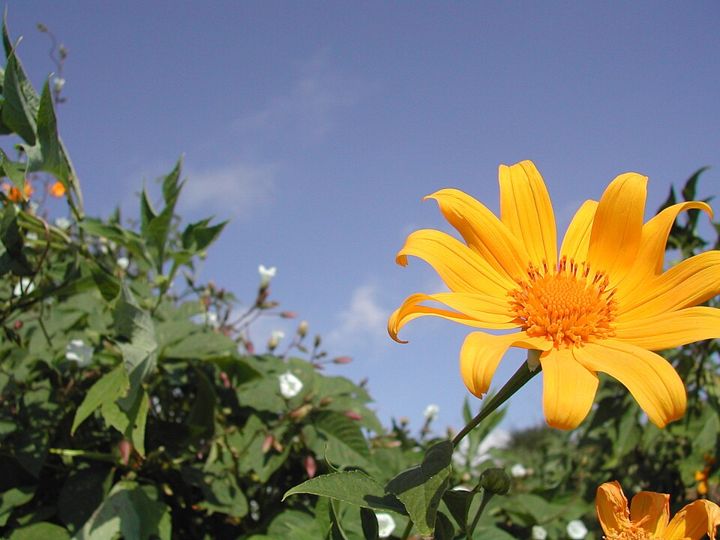
Photo: Thierry Caro, via Wikimedia Commons, public domain / CC0. Unmodified apart from resizing.
Colour
yellow, orange
Region
Singapore and tropical Asia, Japan and temperate East Asia
Season
autumn, winter
Shape
large head
Identification
2–3 m tall with upright, sometimes woody shrub-like stalks. Sub-ovate serrate leaves 10–40 cm long, mostly three- to seven-lobed, somewhat glandular, slightly greyish beneath, alternating from side to side of the stem (hence the epithet diverse-leaved). Large showy honey-scented heads, yellow to orange, 5–15 cm wide, like small sunflowers; called Nitobe chrysanthemum in Japan. Four-angled achenes 5 mm long. It raises the fertility of depleted soils.
Habitat
Roadsides, waste ground, hillsides and river banks at 500–1,600 m, escaping in sheets; used as green manure in the tropics.
Distribution
Native to Mexico and Central America and now naturalised pantropically; introduced to Taiwan in 1910 and to Japan from Central America in 1912 (naturalised in Okinawa), naturalised in Guangdong and Yunnan, grown and escaped in Singapore.
Season and behaviour
October to February in Taiwan and southern China (autumn and winter), winter in Okinawa; April to June in its homeland. It turns winter hillsides yellow.
Photography tips
These are the FilmAnalysis editors' notes, not content from the sources.
Sheets of orange-yellow on a winter hillside compress with a long lens or go wide and low with blue sky; against the light the petals glow and the stems become silhouettes. Head-on for the radiating rays, with the disc florets opening ring by ring as texture. Orange-yellow clips at noon, so early or late.
Photographic styles
Orange-yellow seas on winter hillsides; the head-on graphic of a small sunflower.
None yet. No validated photo recognition exists for this species, so no badge is tied to it: a name in the encyclopedia is not evidence in a photograph.
The illustration is original FilmAnalysis artwork. The photograph is from Wikimedia Commons; its licence and author are under it.
Why it is listed: this species comes from the Flower checklist (GBIF backbone and Wikidata verified). Names follow the GBIF backbone and Wikidata; the facts follow the sources below; photo recognition is not offered.