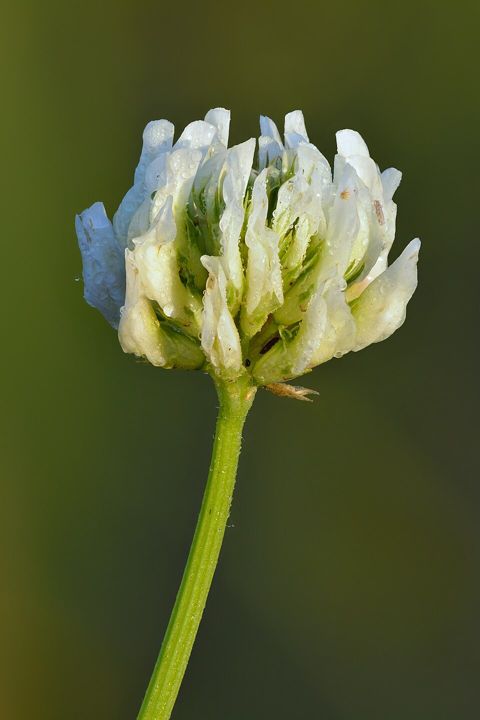
A low herbaceous perennial. Trifoliolate leaves with smooth elliptic to egg-shaped leaflets on long petioles, usually with light or dark V markings; the stems act as stolons creeping up to 18 cm a year and rooting at the nodes, so it forms mats; the leaf is the shamrock, and sometimes carries four or more leaflets. Flower heads 1.5–2 cm across of whitish florets often tinged pink or cream, deepening as the plant ages, at the ends of 7 cm stalks.
Habitat
Lawns, parks, roadsides, pasture and river flats; the most widely cultivated clover, common in grassy places everywhere after introduction as forage.
Distribution
Native to Europe, North Africa and West Asia and widely introduced, especially common in North American grassland; found throughout northern and southern China and all of Japan; absent from Singapore.
Season and behaviour
Flowers from April to August, later in the north and earlier in the south; densest on lawns in late spring, scattered in autumn.
Photography tips
These are the FilmAnalysis editors' notes, not content from the sources.
Lie on the lawn so the white heads become a shallow-focus pattern of dots in green; a macro of one head shows the dozens of tiny pea flowers it is made of. Hunting for a four-leaf clover is the game before the picture. Half a stop under for white, 1/1600 s when bees arrive.
Photographic styles
Dots of white across a lawn; macro of a small flower ball.
Similar species
Red clover (red-purple heads, larger V-marked leaves); alsike clover (pink-white heads, non-creeping stems); woodsorrel leaves are heart-shaped rather than elliptic.
Related badge
None yet. No validated photo recognition exists for this species, so no badge is tied to it: a name in the encyclopedia is not evidence in a photograph.
The illustration is original FilmAnalysis artwork. The photograph is from Wikimedia Commons; its licence and author are under it.
Why it is listed: this species comes from the Flower checklist (GBIF backbone and Wikidata verified). Names follow the GBIF backbone and Wikidata; the facts follow the sources below; photo recognition is not offered.