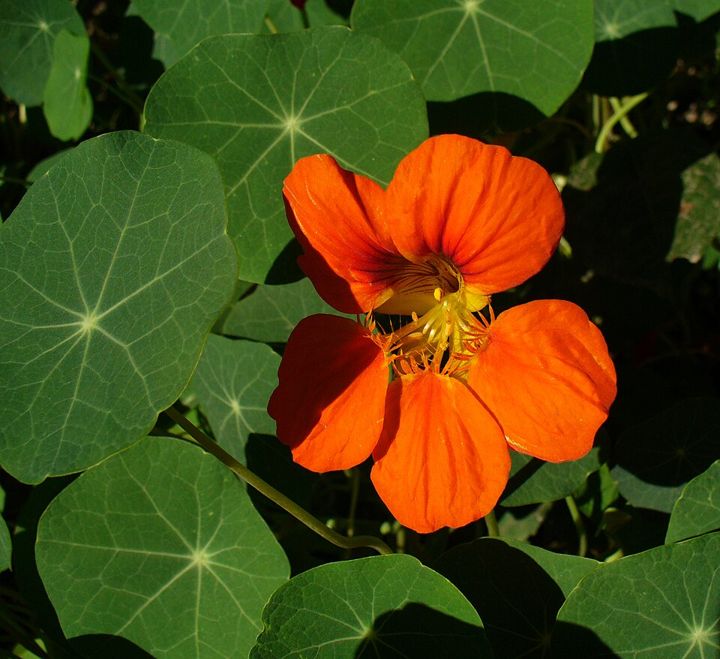
Photo: George Chernilevsky, via Wikimedia Commons, public domain / CC0. Unmodified apart from resizing.
Colour
orange, yellow, red
Region
Japan and temperate East Asia
Season
spring, summer, autumn
Shape
single flower
Identification
A fast-growing annual or short-lived perennial with trailing stems 0.9–1.8 m. Large nearly circular leaves 3–15 cm across, peltate (the stalk joined at the leaf's centre), green to glaucous above and paler below, with radiating veins and smooth or slightly lobed margins, like little lotus leaves, hence the Chinese name dry lotus. Flowers 2.5–6 cm across, mildly scented, with five petals, eight stamens and a 2.5–3 cm spur behind; petals yellow, orange to red, frilled and often darker at the base. A three-segmented fruit with one large seed per segment. Of cultivated and probably hybrid origin, unrelated to the watercress genus Nasturtium. Edible peppery leaves and flowers.
Habitat
Beds, window boxes, balconies and vegetable gardens, liking cool weather and disliking heat; escaped in cool regions.
Distribution
Originating in the Andes from Bolivia to Colombia and of cultivated origin, naturalised worldwide; grown across China, flowering in winter and spring in cool Kunming, common in Japanese beds (kinrenka). Too hot for it in Singapore, where it is scarce.
Season and behaviour
May to October in temperate climates, November to May in Yunnan; each flower lasts days.
Photography tips
These are the FilmAnalysis editors' notes, not content from the sources.
Orange-red flowers against round shield leaves are a ready composition, from above so the radiating veins and the flowers are both in frame; the spur shows only from the side. Water beading on the leaves after rain (the lotus effect) is a macro classic. Warm colours saturate under cloud; half a stop under in sun.
Photographic styles
Water drops on round leaves; orange flowers and shield leaves from above.
Similar species
Chinese globeflower, Trollius chinensis (Ranunculaceae, yellow cup flowers, northern Chinese mountains); other Tropaeolum (mostly climbers); lotus (far larger leaves, aquatic).
Related badge
None yet. No validated photo recognition exists for this species, so no badge is tied to it: a name in the encyclopedia is not evidence in a photograph.
The illustration is original FilmAnalysis artwork. The photograph is from Wikimedia Commons; its licence and author are under it.
Why it is listed: this species comes from the Flower checklist (GBIF backbone and Wikidata verified). Names follow the GBIF backbone and Wikidata; the facts follow the sources below; photo recognition is not offered.