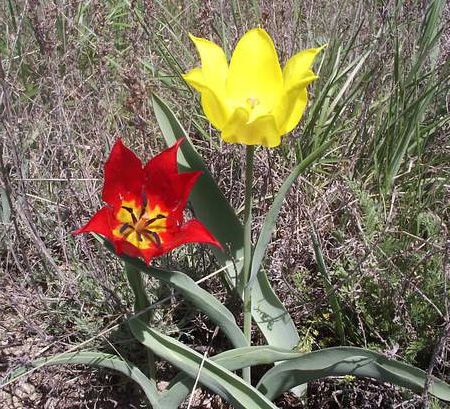
Photo: Katalinks (who is also "Екатерина"), via Wikimedia Commons, public domain / CC0. Unmodified apart from resizing.
Colour
red, yellow, pink, white, purple, orange
Region
Japan and temperate East Asia
Season
spring
Shape
single flower
Identification
A complex hybridised cultigen (also written Tulipa × gesneriana), tall and late, one large flower per stem, with linear or broadly lanceolate grey-green leaves. A cup of six tepals in nearly every colour, often with a dark basal blotch; open in sun, closed in dull weather and at night. Nearly all garden tulip cultivars descend from it. Of tangled origin, bred over centuries from several wild species, Tulipa suaveolens probably an important ancestor; it reached Europe through the Ottoman Empire, and the Dutch tulip mania of the seventeenth century is its history. Naturalised in parts of central and southern Europe. Pollinated by Halictus bees.
Habitat
Beds, fields and pots, needing winter cold to flower; in East Asia mostly a single-season bulb planted in autumn for spring.
Distribution
Of cultivated origin, probably from wild species around the Black Sea and south-eastern Europe; the Netherlands is the bulb centre; grown in quantity in spring beds in northern and eastern China (tulip shows in Beijing, Shanghai, Xi'an), bulbs grown at Tonami in Toyama and in Niigata with spring beds everywhere in Japan (chūrippu), shown in Singapore only in the climate-controlled flower dome.
Season and behaviour
Late March to early May, April in the north, mid to late April in Japan; a single flower lasts about a week, early or late by cultivar.
Photography tips
These are the FilmAnalysis editors' notes, not content from the sources.
The cup has shape only at eye level or slightly below; from above for the dark basal blotch and six stamens; against the light the tepals glow like a lantern, its best picture. A field compresses into bands of colour with a long lens, or go low so a row stands against the sky. Half a stop under for red and orange. Flowers close under cloud, so stay home. Under the artificial light of Singapore's flower dome set white balance by hand.
Photographic styles
Cups glowing against the light; bands of colour across a field.
Similar species
Wild tulips (Tulipa sylvestris and others, small and yellow); Tulipa iliensis (wild in Xinjiang, yellow); other lily-family bulbs (crocuses smaller and ground-hugging).
Related badge
The album badge "a tulip" unlocks when the vision model explicitly names a a tulip in your photo and you rate the analysis. The badge stops at "a tulip": it does not tell species apart, and this page existing unlocks nothing.
The illustration is original FilmAnalysis artwork. The photograph is from Wikimedia Commons; its licence and author are under it.
Why it is listed: this species comes from the Flower checklist (GBIF backbone and Wikidata verified). Names follow the GBIF backbone and Wikidata; the facts follow the sources below; photo recognition is not offered.