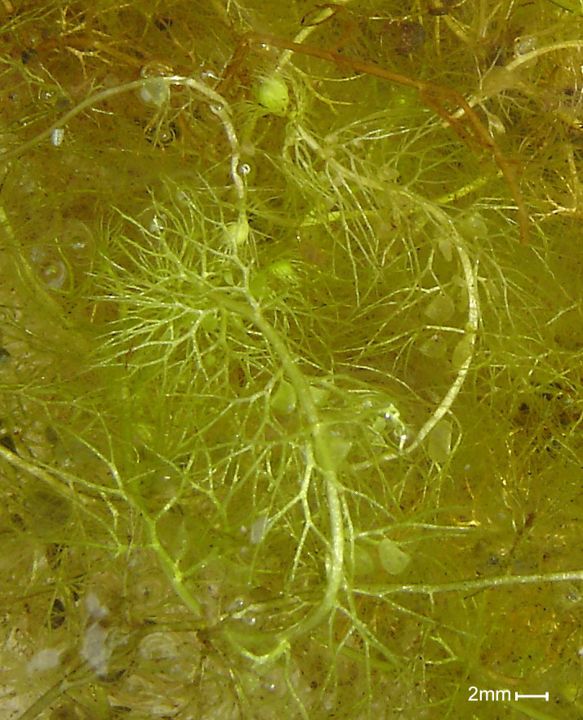
Photo: Veledan~commonswiki, via Wikimedia Commons, public domain / CC0. Unmodified apart from resizing.
Colour
yellow
Region
Japan and temperate East Asia
Season
summer
Shape
spike
IUCN status
Least Concern
Identification
A free-floating carnivorous aquatic without roots. The stems grow to over a metre in a season, die back in winter and form turions that sink. Finely pinnately divided leaves 1–8 cm long carry many bladder traps that suck in water fleas and other small animals by suction. Yellow two-lipped flowers on stalks above the water, the lower lip large with an orange throat mark, from April to August. The most widespread Utricularia.
Habitat
Still ponds, lake bays, marshes and paddies, floating at the surface; needs clean fresh water.
Distribution
Europe and Asia, the most widespread species of its genus; in lakes and marshes from north-east and northern China to the Yangtze basin and in ponds throughout Japan (tanukimo). Absent from Singapore.
Season and behaviour
June to August, the scapes rising above the water in high summer, each flower lasting days; the plant yellows in autumn and forms turions.
Photography tips
These are the FilmAnalysis editors' notes, not content from the sources.
The yellow flowers are a centimetre or two across and a few centimetres above the water: a long macro lens from the bank or a boat, from low down so the flower floats before dark water; half a stop under for yellow. The bladders are an underwater subject, photographed in macro in a clear container (without collecting wild plants).
Photographic styles
Small yellow flowers rising from the water; underwater bladder macro.
Similar species
Utricularia aurea (tropical, larger flowers, common in southern China); Utricularia australis (smaller flowers); other yellow aquatics such as fringed water lily (floating leaves, not finely divided).
Related badge
None yet. No validated photo recognition exists for this species, so no badge is tied to it: a name in the encyclopedia is not evidence in a photograph.
The illustration is original FilmAnalysis artwork. The photograph is from Wikimedia Commons; its licence and author are under it.
Why it is listed: this species comes from the Flower checklist (GBIF backbone and Wikidata verified). Names follow the GBIF backbone and Wikidata; the facts follow the sources below; photo recognition is not offered.