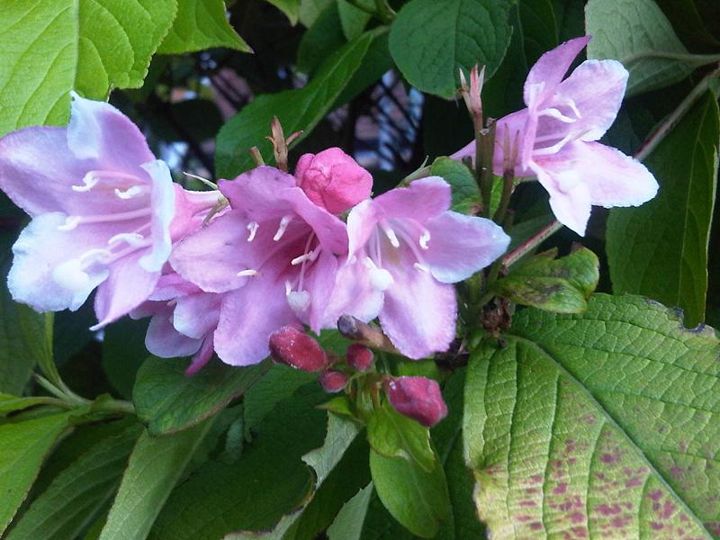
A deciduous shrub to 2.5 m with arching branches. Opposite elliptic toothed leaves. Funnel-shaped flowers about 3 cm long in pairs or clusters in the leaf axils, opening pale pink and deepening to rose, so that light and dark shades hang together along the branch like brocade ribbons, hence the Chinese name brocade-sash flower; cultivars include white, deep red and purple-leaved forms.
Habitat
Scrub and mixed evergreen-deciduous forest at 100–1,450 m; widely planted in gardens, parks and roadside hedges, hardy and tolerant of clipping.
Distribution
Native to Inner Mongolia, north-east, northern and south-central China, Primorsky Krai in the Russian Far East, Korea and Kyushu in Japan; very common in the parks of northern China and commonly grown in Japan; introduced to Britain, Ireland, the United States and elsewhere. Absent from Singapore.
Season and behaviour
Late April to June, peaking in May in the north; a few flowers again in late summer after trimming.
Photography tips
These are the FilmAnalysis editors' notes, not content from the sources.
Strings of pink along arching branches suit a composition following the curve, compressed with a long lens against dark green; the mix of pale and deep pink on one branch is its character, so keep both in the frame. The funnel in side macro, front-lit to show the yellow nectar guides in the throat. Truest under cloud.
Photographic styles
Alternating pinks along an arching branch; the profile of a funnel flower.
Similar species
Weigela coraeensis (opening white and turning red, slimmer tube); Weigela hortensis (Honshu, similar colours); 'Red Prince' weigela (a deep red cultivar).
Related badge
None yet. No validated photo recognition exists for this species, so no badge is tied to it: a name in the encyclopedia is not evidence in a photograph.
The illustration is original FilmAnalysis artwork. The photograph is from Wikimedia Commons; its licence and author are under it.
Why it is listed: this species comes from the Flower checklist (GBIF backbone and Wikidata verified). Names follow the GBIF backbone and Wikidata; the facts follow the sources below; photo recognition is not offered.