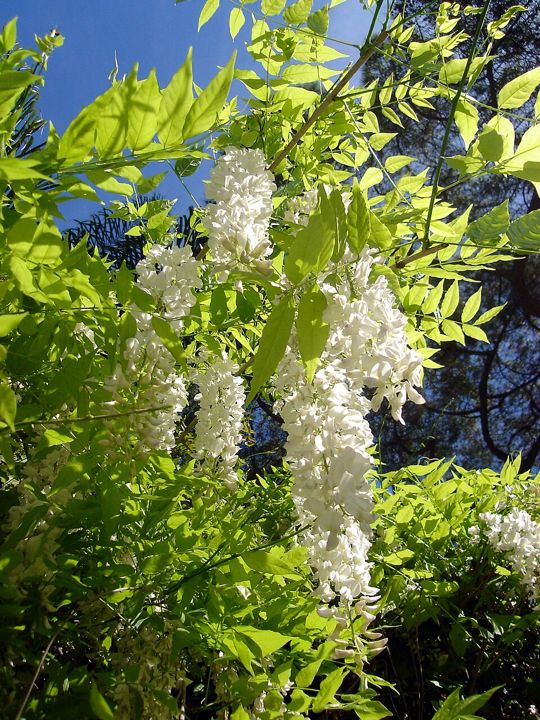
A large woody deciduous vine 20–30 m tall, climbing trees and structures by counterclockwise-twining stems. Glossy odd-pinnate leaves 10–30 cm long with 9–13 oblong leaflets of 2–6 cm, the young leaves downy on both sides. Flowers in spring before the leaves, blue-violet (also white or violet) pea flowers 2.5–4 cm long in racemes of 15–20 cm, all the flowers of a raceme opening at once, with a grape-like scent; shorter racemes than the Japanese wisteria but more of them. Flattened brown velvety pods 5–15 cm that often hang on through winter.
Habitat
Hillsides, forest edge and valleys, and far more often on garden trellises, covered walks and the walls of old buildings; long-lived, with vines centuries old in Beijing and Suzhou.
Distribution
Native to China: Guangxi, Guizhou, Hebei, Henan, Hubei, Shaanxi and Yunnan, mainly in the north; widely grown throughout China, grown in Japan (where most wisteria is the Japanese species), absent from Singapore.
Season and behaviour
Mid-April to early May, before the leaves, about two weeks; late April in the north.
Photography tips
These are the FilmAnalysis editors' notes, not content from the sources.
From under the trellis, looking up at the hanging racemes, the sky through them turns the purple translucent; backlight is its finest light. Blue-violet is truest under cloud and goes grey in strong sun. A covered walk's perspective with racemes wants a wide lens; a single raceme a long one. Before the leaves the bare wood contrasts with the purple, so do not wait for the foliage.
Photographic styles
Purple racemes seen from under the trellis; the perspective of a covered walk.
Similar species
Japanese wisteria (racemes 30–90 cm, clockwise twining, flowers opening in sequence, with the leaves); Wisteria villosa (short racemes, same genus); kudzu (small flowers, summer).
Related badge
None yet. No validated photo recognition exists for this species, so no badge is tied to it: a name in the encyclopedia is not evidence in a photograph.
The illustration is original FilmAnalysis artwork. The photograph is from Wikimedia Commons; its licence and author are under it.
Why it is listed: this species comes from the Flower checklist (GBIF backbone and Wikidata verified). Names follow the GBIF backbone and Wikidata; the facts follow the sources below; photo recognition is not offered.