Japan and temperate East Asia, Singapore and tropical Asia
Season
spring, summer
Shape
single flower
IUCN status
Least Concern
Identification
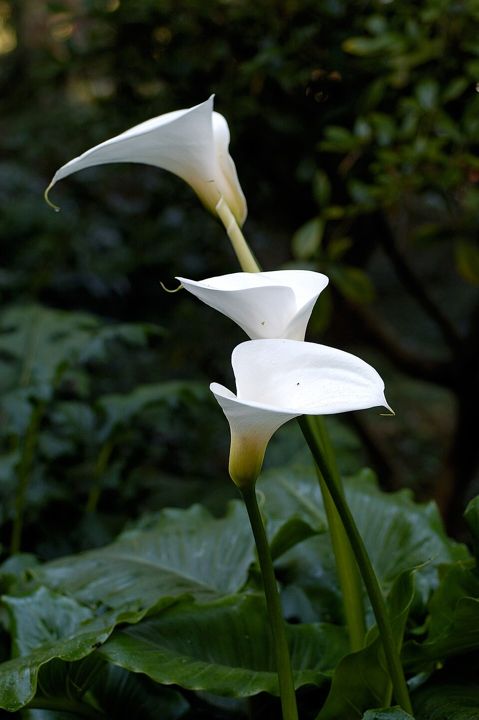
A rhizomatous perennial, evergreen where rain and warmth allow and deciduous where there is a dry season, 0.6–1 m tall. Large arrow-shaped dark green leaves up to 45 cm in big clumps. The flower is an inflorescence: a pure white spathe like a horse's hoof or a funnel, up to 25 cm, round a yellow spadix up to 9 cm with a faint sweet scent, the true flowers tiny and packed on the spadix. The plant contains calcium oxalate and burns the mouth if eaten. A classic cut flower and wedding bloom.
Habitat
Streamsides, pond margins and wetlands, rooted in wet mud; grown as a wetland flower and cut flower, naturalised as a weed in places.
Distribution
Native to southern Africa (South Africa, Lesotho, Eswatini, Mozambique); a cut and pot flower across China, in open fields in Yunnan and Taiwan (the calla season at Zhuzihu on Yangmingshan), common in Japanese beds and florists (kaiu), grown in Singapore's cool-house gardens.
Season and behaviour
Spring, summer and autumn, peaking March to June in temperate climates and March to May on Yangmingshan; one spathe lasts over two weeks.
Photography tips
These are the FilmAnalysis editors' notes, not content from the sources.
The curve of the white funnel is the subject itself: side light for the rolled edge and its shadow, a stop under to keep the texture of white; from above for the yellow spadix inside. Calla fields in mist at Zhuzihu are a Taiwanese spring sight, wide and low. Cut stems in window light for silhouette-like curves. The sap irritates; keep it from your eyes.
Photographic styles
The curve of a white funnel; calla fields in mist.
Similar species
Coloured callas (Zantedeschia hybrids, yellow, pink and purple with white-spotted leaves); anthurium (flat waxy spathe); taro relatives (inconspicuous green spathes).
Related badge
None yet. No validated photo recognition exists for this species, so no badge is tied to it: a name in the encyclopedia is not evidence in a photograph.
The illustration is original FilmAnalysis artwork. The photograph is from Wikimedia Commons; its licence and author are under it.
Why it is listed: this species comes from the Flower checklist (GBIF backbone and Wikidata verified). Names follow the GBIF backbone and Wikidata; the facts follow the sources below; photo recognition is not offered.