Japan and temperate East Asia, Singapore and tropical Asia
Season
summer, autumn
Shape
single flower
Identification
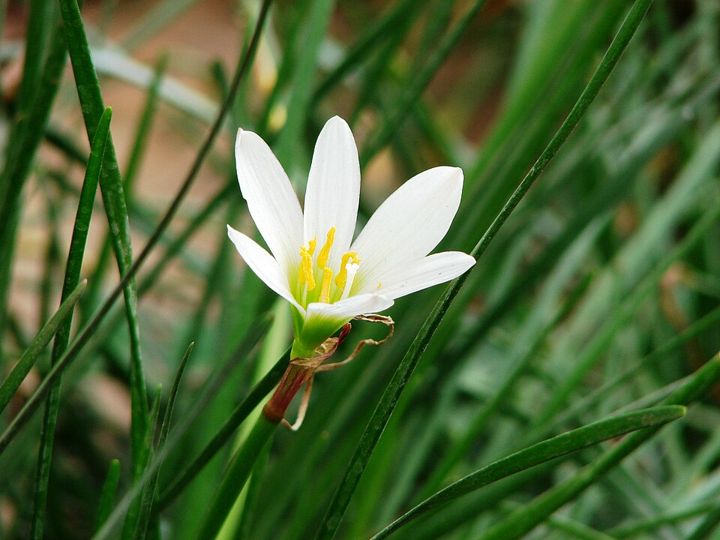
A bulb with deep glossy green leaves, linear like chives and about 3 mm wide, hence the Chinese name onion orchid. The bud emerges from a papery spathe looking at first like a new leaf, then opens to a stunning white upright flower of six tepals, sometimes pinkish on the back, with a yellow-green centre; the bract is 1.8–4 cm. It flowers in flushes after rain, hence rain lily.
Habitat
Bed edges, roadside groundcover, lawns and gardens, in full sun to part shade and medium-moist soil; so easily propagated by offsets that it forms sheets.
Distribution
Native to South America (Argentina, Uruguay, Paraguay, Brazil); widely cultivated and naturalised in central and southern China, Korea, the Ryukyus, South Asia, southern Africa and Pacific islands. Very common in the greenery of Chinese cities north and south, grown from Honshu south in Japan, and common in Singapore's beds.
Season and behaviour
August to October, whole sheets opening together within two or three days of heavy rain, each flower lasting three or four days; buds from late August in the northern hemisphere.
Photography tips
These are the FilmAnalysis editors' notes, not content from the sources.
After rain is the only moment: find a patch flowering together at a bed edge and compress the white from low down with a long lens against wet dark green. A head-on macro for the yellow-green centre and six tepals, half a stop under for white. Petals still carrying raindrops are best.
Photographic styles
White groundcover opening together after rain; macro with water drops.
Similar species
Pink rain lily (pink flowers, flat chive-like leaves); onion (globular heads); narcissus (spring, with a corona).
Related badge
None yet. No validated photo recognition exists for this species, so no badge is tied to it: a name in the encyclopedia is not evidence in a photograph.
The illustration is original FilmAnalysis artwork. The photograph is from Wikimedia Commons; its licence and author are under it.
Why it is listed: this species comes from the Flower checklist (GBIF backbone and Wikidata verified). Names follow the GBIF backbone and Wikidata; the facts follow the sources below; photo recognition is not offered.