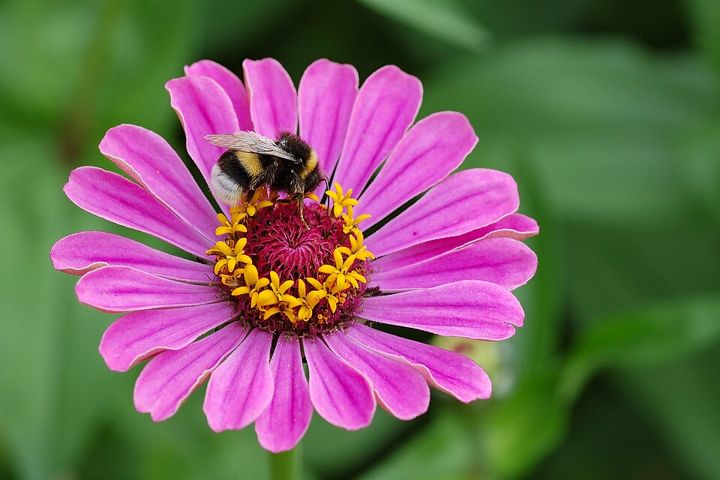
Japan and temperate East Asia, Singapore and tropical Asia
Season
summer, autumn
Shape
single flower
Identification
An annual, about 15 cm in the wild and 30–100 cm in cultivars. Opposite lanceolate leaves, stalkless and clasping, rough. Solitary heads about 5 cm across (over 10 cm in cultivars), the wild type with purple rays round black and yellow discs; cultivars red, pink, orange, yellow, white, green, purple and double, the disc florets opening as a ring of little yellow stars. A long season, hence the Chinese name hundred-day herb.
Habitat
Beds, borders, vegetable-garden edges and roadsides in sun and heat, one of the most used summer annuals; native to the dry grasslands of Mexico.
Distribution
Native to Mexico, introduced worldwide as an ornamental and naturalised in the Americas, the West Indies, the United States, Australia and Italy; grown across China, common in Japanese summer beds (hyakunichisō), grown in Singapore.
Season and behaviour
June to October, peaking in summer; sown all year in the tropics. One flower lasts two or three weeks.
Photography tips
These are the FilmAnalysis editors' notes, not content from the sources.
Straight down is its most graphic angle, with the ray arrangement and the ring of yellow stars on the disc all in one plane; colours truest in soft light. A many-coloured bed compresses into blocks with a long lens. Butterflies love it, 1/1600 s. The disc florets open ring by ring, a texture for macro.
Photographic styles
Colour graphics seen from above; blocks of bedding colour with butterflies.
Similar species
Narrow-leaved zinnia (low, small orange-yellow flowers); dahlia (tuberous, larger flowers, compound leaves); cosmos (thread-like leaves, single flowers).
Related badge
None yet. No validated photo recognition exists for this species, so no badge is tied to it: a name in the encyclopedia is not evidence in a photograph.
The illustration is original FilmAnalysis artwork. The photograph is from Wikimedia Commons; its licence and author are under it.
Why it is listed: this species comes from the Flower checklist (GBIF backbone and Wikidata verified). Names follow the GBIF backbone and Wikidata; the facts follow the sources below; photo recognition is not offered.